
What Should Gatlinburg Cabin Owners Check Before the First Hard Freeze?
PUBLISH DATE: October 1, 2026
Leaf season fills the Smokies, and then it empties them. By late November, the crowds thin, temperatures at higher elevations can drop well below conditions in Sevierville, and a Gatlinburg cabin that has been running at full occupancy since June may start sitting empty for longer stretches.
That is when expensive winter failures can happen — not during the busy season, when someone is there every night to notice a smell or sound, but in January, when a supply line lets go in an unoccupied cabin at two in the morning, and nobody finds it for four days.
October is the month to prepare for that possibility. A pre-winter cabin walkthrough can help owners review plumbing, decks, roofing, heating systems, trees, crawl spaces, alarms, and other areas before the first hard freeze.
Here is the walkthrough worth doing before winter, whether you live in the property, rent it as a short-term rental, or do both.
Why Is Elevation Important When Winterizing a Gatlinburg Cabin?
Because the forecast for Gatlinburg is not always the forecast for your cabin.
A property located higher on a ridge can run several degrees colder than town, hold ice long after the valley has thawed, and lose power during weather that barely registers at lower elevations. If your cabin sits on a steep access road, a service truck that can reach the property in October may not be able to reach it easily in January.
That changes the calculation for every winter maintenance item below.
A repair you defer now is not simply a repair you do later — it may become a repair that somebody cannot reach for several days once winter weather arrives.
What Is the Highest-Risk Winter Item for a Gatlinburg Cabin?
Plumbing in unheated or under-heated spaces. It is not close.
A burst supply line in an unoccupied mountain cabin can become one of the most costly common winter failures because the water may continue running until someone arrives.
Before the first hard freeze:
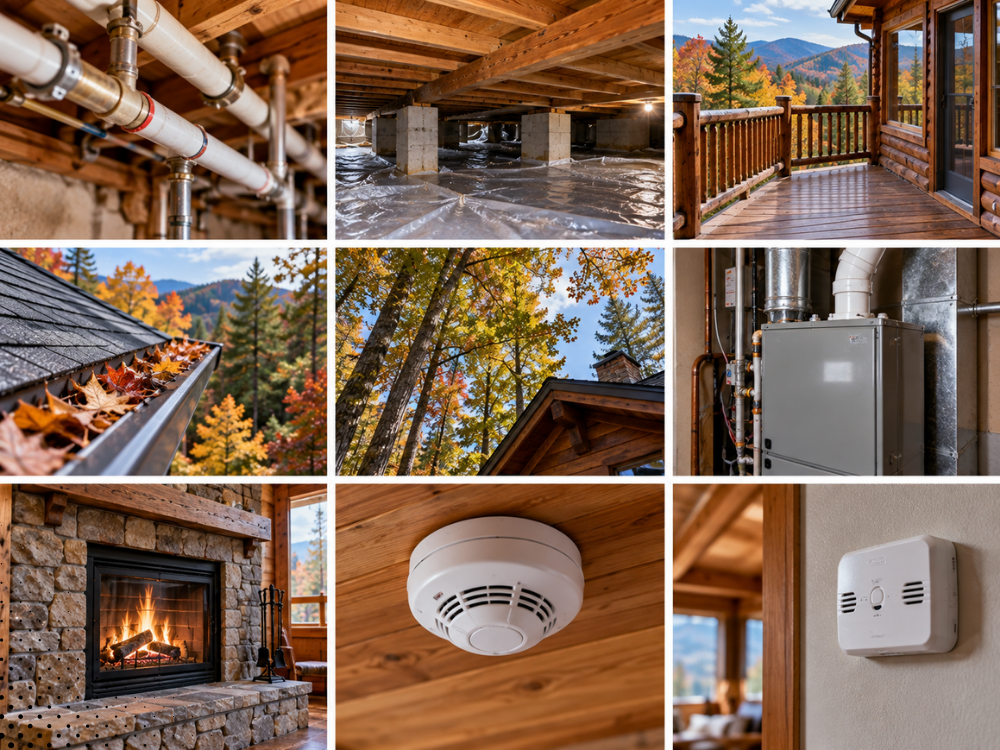
Trace every line running through a crawl space, unheated garage, exterior wall, or beneath a cantilevered floor. These are vulnerable runs during freezing conditions. Insulate them properly — foam sleeves, not just a wrap of fiberglass.
Disconnect and drain all hoses. Shut the interior valve to each hose bib and open the exterior spigot so the line can drain.
Confirm the crawl space is closed up. Check vents, the access door, and any gaps where freezing air can sit directly against plumbing.
Set the thermostat and never turn the heat fully off between guests. A cabin allowed to drop to ambient temperature is more vulnerable to frozen plumbing.
Know where the main water shutoff is. Make sure your cleaner, property manager, and anyone else with access knows where it is too. Being able to stop the water quickly can significantly limit the amount of water released inside the cabin.
Consider a freeze or leak alarm if the property sits empty for stretches. A low-temperature alert that reaches your phone can provide useful notice when nobody is at the property.
What Should Gatlinburg Cabin Owners Check on the Deck Before Winter?
Inspect the deck deliberately because mountain cabin decks can contain some of the property's most consequential safety-related components.
Cabins throughout Gatlinburg and the Smoky Mountains are often built on slopes, and the deck is frequently one of the main reasons guests book the property. It is also elevated, exposed to weather year-round, and regularly carries loads from occupants.
Look at the ledger where the deck attaches to the house and the flashing above it. Water getting behind a ledger can affect the connection over time.
Also check:
Post-to-beam connections
Post-to-footing connections
Fastener corrosion
Guard height
Baluster spacing
Stair stringers
Stair treads
Anything soft, rusted, loose, or moving deserves a professional look before additional freeze-thaw cycles and winter weather affect the area.
What Does Ice Do to a Smoky Mountain Cabin Property?
Ice adds weight to trees and roof areas, and in the Smokies, trees can be one of the primary winter hazards around a cabin.
Before winter:
Walk the tree line and look up. Check for dead limbs, split crotches, and anything overhanging the roof, driveway, or overhead electrical service drop. Tree removal and pruning are arborist work, not ladder work, and crews may still have greater availability in October.
Clear limbs and leaf litter from the roof surface, especially in valleys and behind chimneys. Wet debris can hold moisture against the roof covering.
Clean the gutters, then clean them again after the surrounding tree canopy finishes dropping its leaves.
Check the overhead service drop where it attaches to the property, including the mast, weather head, and drip loop. Damage or sag should be evaluated by an electrician.
Plan for a power outage. Ice can interrupt power in mountain communities. Know how the property will maintain heat, and never operate a generator or grill inside a garage, crawl space, or beneath a deck.
What Should You Check on the Heating System and Carbon Monoxide Alarms?
Run the heating system before you need it, preferably on a mild fall day when a service call is still routine rather than an emergency.
Have the system serviced on its normal maintenance schedule and change the filter.
If the Gatlinburg cabin has a wood stove or fireplace — as many mountain cabins do — have the chimney swept and inspected, confirm that clearances to combustible materials are appropriate, and verify that the damper operates correctly.
Then test every smoke alarm and carbon monoxide alarm in the property.
This is particularly important in a short-term rental. Combustion appliances, gas logs, attached garages, fireplaces, and guests who may be unfamiliar with the property all make functioning alarm coverage important.
The U.S. Fire Administration publishes current guidance on smoke alarm placement and replacement intervals, and every sleeping area needs appropriate coverage.
What Should Gatlinburg Short-Term Rental Owners Check Before Winter?
Short-term rental cabins have additional considerations because high-turnover occupancy means different guests regularly use the property's systems, stairs, decks, hot tubs, and exterior walking surfaces.
For a Gatlinburg Airbnb, VRBO, or other vacation rental, review:
Hot tub electrical and bonding, along with the cover and surrounding walking surface, which may become slippery or icy during winter.
Egress from every sleeping area, including loft spaces that are being used as bedrooms.
Handrails and guards on every stair and elevated walkway — areas that deserve particular attention in a mountain rental.
Exterior lighting and walking surfaces guests use after dark, particularly sloped approaches that may ice over.
Smoke and carbon monoxide alarm coverage in every required location. Test the alarms rather than assuming they are working.
The access road and parking area. Consider whether a guest arriving in a rental car can realistically enter and leave the property during winter conditions.
Is a Pre-Winter Cabin Inspection Worth It?
For many Smoky Mountain cabin owners, yes — especially if you manage the property remotely or if nobody has recently been on the roof, under the deck, or inside the crawl space.
A maintenance inspection is different from a real estate transaction inspection because nothing is being negotiated.
Instead, it is a walkthrough of accessible areas and systems that may include:
Roof
Attic and ventilation
Structure
Crawl space
Plumbing
Electrical system
Heating system
Decks
Drainage around the property
The goal is to produce a written record of what appears fine, what should be monitored, and what may need attention before winter.
The value is largely in the timing.
Many conditions identified in October can be handled as scheduled maintenance while roads are clear and contractors can access the property. The same condition discovered during January weather may require an emergency service call when access is more difficult.
What Smoky Mountain Cabin Owners Ask Most
Should I Turn the Heat Off Between Guests to Save Money?
No. Setting the temperature back is reasonable; turning the heat completely off can allow plumbing to freeze.
A mountain cabin allowed to drop toward ambient temperature during freezing weather is considerably more vulnerable to frozen pipes, particularly where supply lines pass through crawl spaces, exterior walls, garages, or other underheated areas.
What Is the Most Expensive Thing That Can Go Wrong in an Empty Cabin?
A burst supply line can become extremely expensive because water may continue running until someone arrives at the property.
Insulating vulnerable plumbing runs, closing the crawl space, maintaining heat, knowing the location of the main shutoff, and installing a low-temperature or leak alert can all reduce exposure to that situation.
How Often Should a Gatlinburg Cabin Deck Be Inspected?
For an elevated mountain cabin deck exposed to year-round weather, an annual inspection is sensible, and timing it before winter is useful.
Important areas include the ledger attachment, flashing, post-to-beam and post-to-footing connections, fasteners, stairs, guards, and other components affected by weather exposure and repeated freeze-thaw cycles.
Does a Maintenance Inspection Cover a Short-Term Rental Differently?
The general inspection scope is the same, but life-safety items receive additional attention when the property regularly hosts guests.
These may include smoke and carbon monoxide alarm coverage, sleeping-area egress, guards and handrails, exterior walking surfaces, and hot tub electrical and bonding.
My Cabin Is on Well and Septic. What Should I Do Before Winter?
Protect the well house and any exposed water lines from freezing, and know the septic system's service history.
Well and septic evaluations are separate from a standard home inspection, but both become especially important for Smoky Mountain cabins with heavy or seasonal occupancy.
What Areas Are Covered for Cabin Inspections?
We cover Gatlinburg, Pigeon Forge, Sevierville, Wears Valley, Cosby, and surrounding Sevier County communities.
Call to confirm availability for your specific property address, including cabins located on steep or gravel access roads.
How Long Does a Cabin Inspection Take?
A cabin inspection typically takes two and a half to four hours, with additional time sometimes needed for larger multi-level cabins with extensive decking, hot tubs, or detached structures.
The written report includes photographs, condition notes, and repair recommendations.
Prepare Your Gatlinburg Cabin Before the First Hard Freeze
The mountain closes the easy maintenance window quickly, and winter conditions do not depend on whether your cabin is ready.
Schedule your pre-winter cabin inspection — call (865) 658-1050 while roads are clear and service access is easier.
Want to know exactly what gets covered? See the full list of inspection services for Gatlinburg and the surrounding Smoky Mountains.