
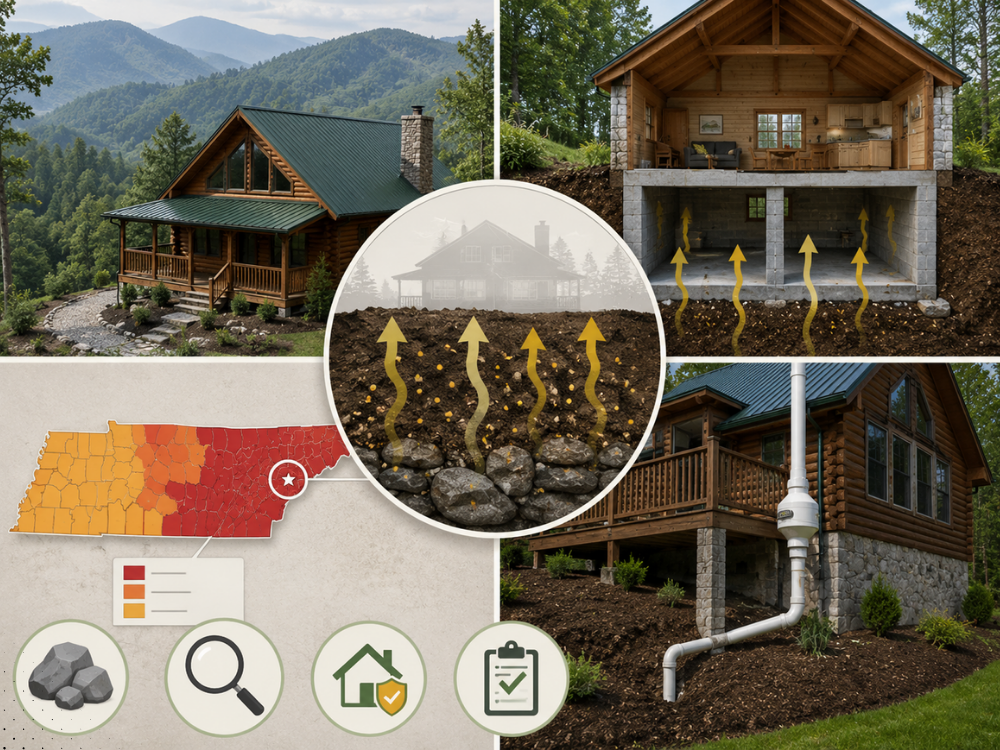
Accu-Spec Home Inspections diagram showing soil gas and radon entry pathways into a log cabin crawl space and basement.
Published: August 1, 2026
Radon testing in Gatlinburg, TN determines whether an invisible radioactive gas is accumulating inside a cabin or mountain home. Radon forms naturally from uranium in soil and rock, and a property can have elevated levels regardless of its age, appearance, elevation, or foundation type. Testing is the only reliable way to determine the indoor radon level.
For homes in Gatlinburg, Wears Valley, and Cosby, testing is especially relevant because East Tennessee has geology associated with elevated radon potential. The EPA’s Tennessee radon map places Sevier County in Zone 1, the category with the highest predicted likelihood of average indoor levels exceeding 4 picocuries per liter. However, the map cannot predict the result for an individual home, so each property still needs its own test.
Why Radon Can Build Up in Mountain Homes
Radon moves from the ground into a building when the pressure inside the home is lower than the pressure in the surrounding soil. Entry routes may include:
Cracks in concrete slabs
Open crawl-space soil
Foundation joints
Gaps around plumbing and utility lines
Floor drains and sump areas
Openings around foundation walls
Mountain cabins are not automatically protected because they sit on a slope, have elevated floors, or use log construction. A cabin may have a slab, a basement, a vented crawl space, an encapsulated crawl space, or a combination of foundation types. Each design can create different pathways for soil gas to enter.
Seasonal conditions may also affect radon readings. Heating systems, closed windows, rainfall, soil moisture, and air-pressure changes can influence how much soil gas is drawn toward the building. Radon cannot be detected by its appearance or smell.
Are Gatlinburg Cabins at Greater Risk?
A cabin’s radon level cannot be determined by its location or construction alone. However, local geology makes testing a practical consideration for property owners and buyers.
The Tennessee Radon Program reports that elevated levels are more prevalent in East Tennessee, although results requiring action have been found in every Tennessee county. The program also reports that approximately one in four homes using its free testing program recorded results above 4 pCi/L.
Cabin characteristics that may affect testing and mitigation include:
Crawl spaces with exposed soil
Finished lower levels used as bedrooms or recreation rooms
Mixed slab-and-crawl-space foundations
Utility penetrations through floors or foundation walls
Additions constructed on a different foundation system
Tight construction with limited natural air exchange
The important question is not whether a cabin appears likely to have radon. It is what a properly placed test measures under the required conditions.
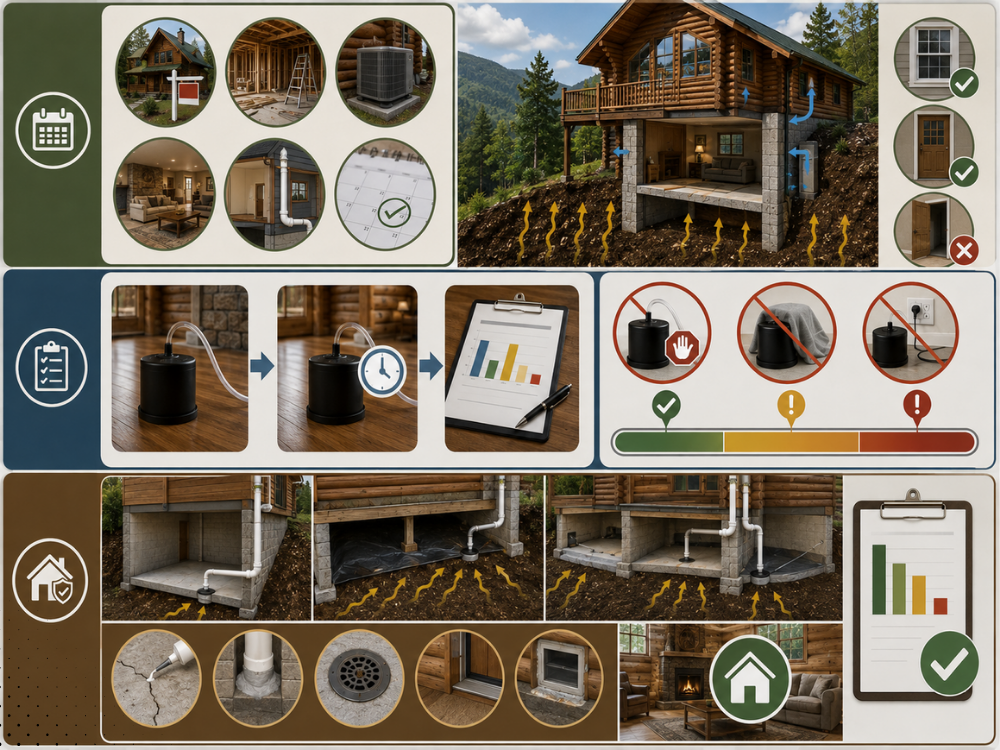
When Should You Schedule Radon Testing?
Radon testing may be appropriate:
During a real estate transaction
After a major renovation
After significant HVAC changes
When finishing a basement or lower level
After installing a radon mitigation system
As part of periodic property monitoring
For buyers, the test should be completed during the inspection and due diligence period. The testing device is typically placed in the lowest level that could be regularly occupied.
Closed-building conditions are generally required during short-term testing. Windows should remain closed, and exterior doors should be used only for normal entry and exit to avoid distorting the results.
Testing may be especially useful when purchasing a cabin with a basement bedroom, lower-level game room, or finished space close to the ground.
What Happens During Professional Radon Testing?
A qualified measurement professional places a radon-testing device in an appropriate location and documents the test conditions. The device remains in place for the required measurement period, after which the collected data is reviewed and reported.
Property occupants and guests should avoid moving, covering, unplugging, or otherwise interfering with the equipment during the testing period.
The report should state the measured radon concentration in picocuries per liter, commonly written aspCi/L. The EPA recommends taking action to reduce radon at 4 pCi/L or higher and considering action when the result falls between 2 and 4 pCi/L.
What If the Radon Result Is Elevated?
An elevated test result does not necessarily mean the property should be abandoned. Radon can often be reduced with a properly designed mitigation system.
The appropriate method depends on the foundation:
A slab or basement may use active sub-slab depressurization, which draws soil gas from beneath the concrete and vents it outdoors.
A crawl-space home may use a sealed membrane over the soil with suction beneath the membrane.
A cabin with multiple foundation types may require multiple suction points or a combined system.
Sealing visible openings can support a mitigation system, but sealing alone is generally not considered a complete radon solution.
A certified radon mitigation professional should evaluate the property and design the system. The home should then be tested again after installation to confirm that the system is reducing the radon level.
Frequently Asked Questions About Radon Testing
Can a log cabin have elevated radon?
Yes. Radon is related to soil gas entering the building, not the material used for the exterior walls. Log cabins, conventional houses, new construction, and older homes can all have elevated levels.
Does a vented crawl space prevent radon?
Not necessarily. Crawl-space ventilation does not guarantee a low indoor radon result. Testing is still needed, particularly when air from the crawl space can move into the occupied areas.
Can I rely on my neighbor’s radon result?
No. Radon levels can vary between nearby properties because soil conditions, foundation openings, pressure differences, and construction details differ.
Is radon testing included in a standard home inspection?
Radon testing is generally scheduled as a separate service or an addition to the home inspection. Confirm the requested services when booking the appointment.
Schedule Radon Testing in Gatlinburg, TN
Accu-Spec Inspection Services provides professional radon testing in Gatlinburg, TN for homes, cabins, and mountain properties in Gatlinburg, Wears Valley, Cosby, and surrounding Smoky Mountain communities.
Tom Maides has been an ASHI Member since 1995 and brings extensive ICC inspection and building-code experience to each property evaluation.
Call Tom at (865) 658-1050 or schedule your radon test online.