Radon in Smoky Mountain Cabins: What Every Gatlinburg Property Buyer Should Know Before Closing
Published: August 2026
The Smoky Mountains draw buyers for obvious reasons: mountain views, clean air, a cabin tucked into the trees, and one of the most active short-term rental markets in the country. What most of those buyers never think to ask about is the soil beneath the cabin they are purchasing — and whether the geological conditions under the Great Smoky Mountains might be delivering something dangerous into the living space.
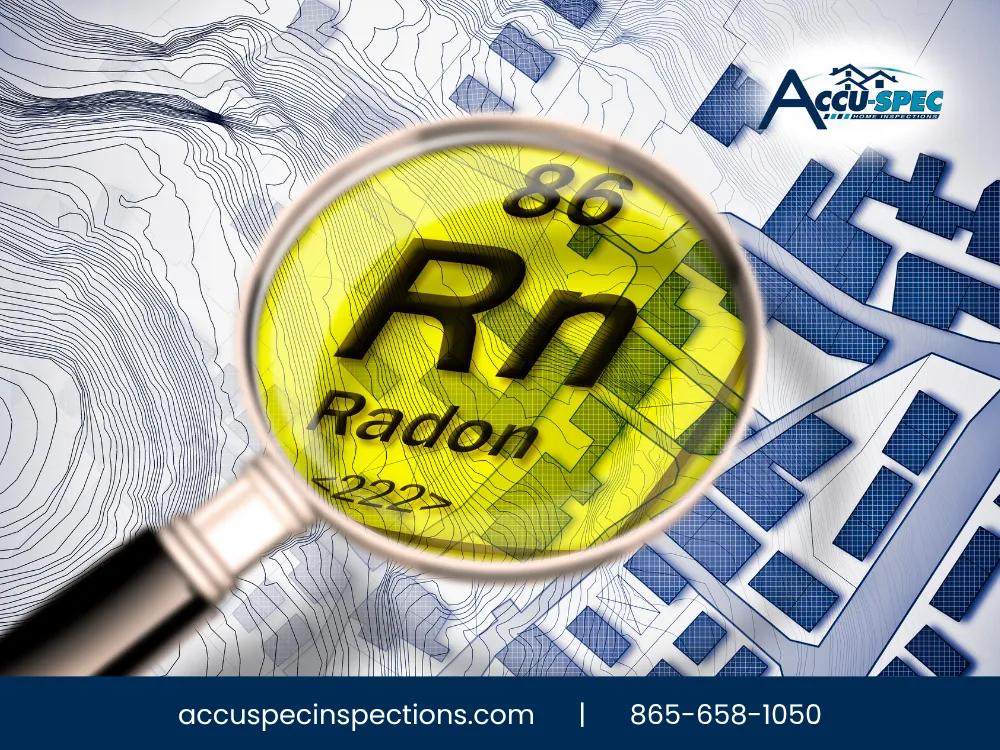
Radon is a colorless, odorless, radioactive gas produced by the natural breakdown of uranium and radium in rock and soil. In East Tennessee, those geological conditions are not subtle. The Appalachian mountain range — the Smokies included — sits on ancient crystalline rock formations that are among the highest uranium-bearing bedrock in the eastern United States. That geology creates elevated radon potential across Sevier County, and the terrain that makes these properties so visually stunning also makes them meaningfully higher risk.
Accu-Spec Inspection Services has been inspecting properties in the Gatlinburg, Sevierville, and Pigeon Forge area since 1993. Radon testing is one of the most important add-on services Tom Maides recommends for buyers in this market — and one of the most frequently skipped by buyers who either did not know about the risk or assumed that mountain air means safe air. It does not.
Why the Smoky Mountain Geology Makes Radon a Real Concern
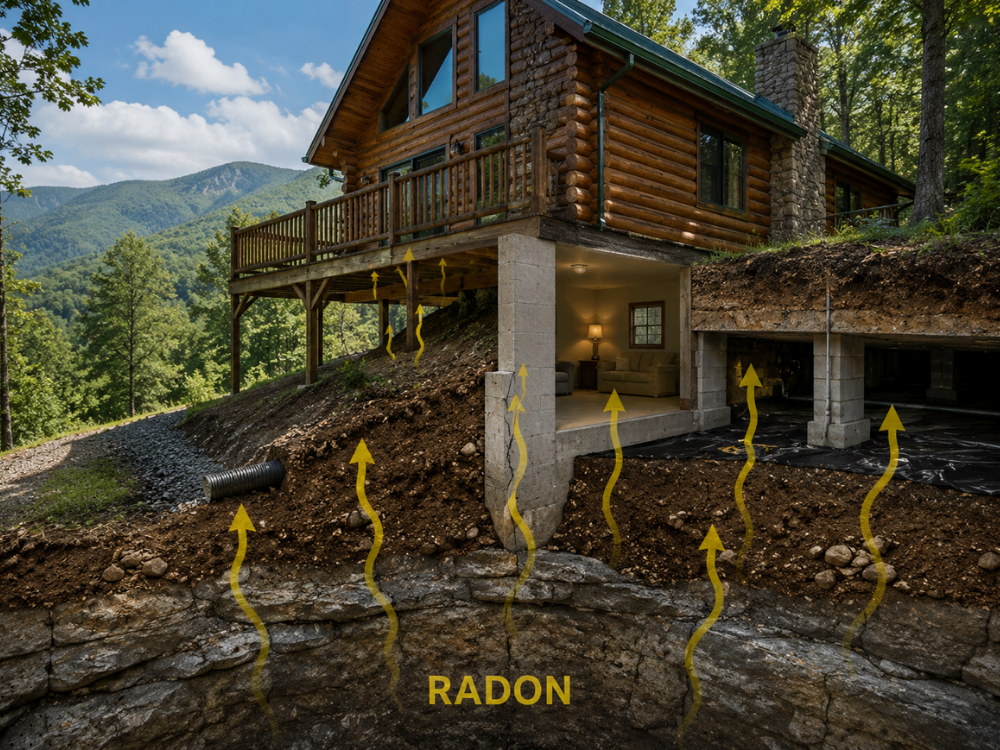
Radon risk is determined primarily by what is in the ground beneath the structure. Uranium-bearing rock — specifically granite, gneiss, and schist, all of which appear in the Appalachian basement rock system — produces uranium decay that eventually becomes radon gas. That gas seeps upward through the soil and enters structures through cracks in slabs, crawl space floors, gaps around utility penetrations, and any other pathway from the ground into the living environment.
The United States Environmental Protection Agency (EPA) designates counties into radon zones, with Zone 1 representing the highest predicted average indoor radon levels. Sevier County, Tennessee, falls in EPA Radon Zone 2 — indicating predicted indoor radon levels between 2 and 4 picocuries per liter (pCi/L). The EPA recommends remediation for any home testing above 4 pCi/L and consideration of action starting at 2 pCi/L. Zone 2 means the statistical baseline is already within the caution range, and individual properties can test significantly higher depending on construction type, foundation design, and proximity to local bedrock.
The cabin construction most common in the Gatlinburg area creates its own set of risk factors. Many Smoky Mountain cabins are built directly into hillsides — sometimes with a lower story or crawl space that is partially or fully below grade on the uphill side. That below-grade exposure means more direct soil contact, more potential entry points, and less natural ventilation to dilute any radon that does enter. Vacation cabins that are unoccupied between guest stays with windows closed and HVAC off can accumulate higher indoor concentrations than a continuously occupied primary residence would.
Who Is Most at Risk — and Why Vacation Rental Buyers Need to Pay Attention
Two groups of Gatlinburg buyers face elevated radon risk, for different reasons.
The first is the primary resident or second-home buyer who will spend extended time in the property. Long-term radon exposure is the mechanism behind the health risk — radon is the second leading cause of lung cancer in the United States, behind only smoking, according to the EPA. The risk compounds with years of exposure, which means someone purchasing a cabin they intend to use as a primary residence or for frequent personal use is exactly the person who should insist on radon testing before closing.
The second group is the investment buyer purchasing a short-term rental cabin. This group often skips inspections entirely or orders only a minimal inspection under the pressure of a fast-moving market with tight contingency windows. That is a mistake for several reasons, including radon. If a property tests high for radon, buyers have documented leverage to negotiate a mitigation system — a cost that typically runs $800 to $2,500 depending on the structure. If a property closes without testing and an investor later discovers elevated radon levels, the full remediation cost falls on the new owner, with no recourse.
What Radon Testing Looks Like on a Smoky Mountain Property
Radon testing during the home inspection process uses a short-term test canister — typically a charcoal-based passive device — placed in the lowest livable level of the home for 48 to 96 hours. For mountain cabins on hillside terrain, that often means the lower floor, the basement level if present, or the primary living area if the structure has no below-grade space. Tom places the test at the beginning of the inspection window and coordinates collection timing with the transaction timeline.
Results come back from an accredited laboratory within a few days. If the tested level exceeds 4 pCi/L, the report documents the finding, and buyers have a basis to request a radon mitigation system as a repair item or to negotiate a price adjustment to cover the installation cost. Mitigation systems for crawl space and slab construction are well-established technology — sub-slab depressurization and crawl space pressurization systems are effective and widely available in the Sevierville and Gatlinburg area.
Frequently Asked Questions About Radon Testing
Is radon actually a problem in the Smoky Mountain area of Tennessee?
Yes. Sevier County falls in EPA Radon Zone 2, meaning predicted average indoor levels are already within the caution range. The underlying Appalachian geology — crystalline basement rock, including uranium-bearing granite, gneiss, and schist — produces radon gas that migrates into structures through contact with the soil at the foundation. Mountain terrain and below-grade cabin construction increase the likelihood of elevated levels in individual properties. Every buyer in the Gatlinburg area should have the property tested.
How does cabin construction affect radon levels in Gatlinburg TN?
Significantly. Many Smoky Mountain cabins are built into hillside terrain, which creates partial or full below-grade foundation exposure on the uphill side — more soil contact, more potential radon entry points, and less natural dilution ventilation than an above-grade structure. Crawl spaces are common in mountain cabin construction and represent a primary radon entry pathway.
How does cabin construction affect radon levels in Gatlinburg TN?
Significantly. Many Smoky Mountain cabins are built into hillside terrain, which creates partial or full below-grade foundation exposure on the uphill side — more soil contact, more potential radon entry points, and less natural dilution ventilation than an above-grade structure. Crawl spaces are common in mountain cabin construction and represent a primary radon entry pathway.
Should vacation rental investment buyers test for radon before closing in Sevier County?
Yes, particularly if the buyer intends to use the property personally or rent it out to guests over multiple years. If elevated radon is found before closing, the buyer can negotiate mitigation as a repair item or a price reduction — a cost that typically ranges from $800 to $2,500. If the property closes without testing and elevated levels are discovered later, the remediation cost falls entirely on the new owner.
What does radon testing add to a home inspection in Gatlinburg TN?
Accu-Spec offers radon testing as an add-on to the standard home inspection. A short-term test canister is placed in the lowest livable level during the inspection window and sent to an accredited laboratory. If levels exceed EPA action guidelines, the inspection report documents the finding, and Tom walks buyers through their options. The cost of testing is a fraction of what remediation costs if the problem is discovered after closing.
Book Your Gatlinburg Area Inspection — Radon Testing Available
Radon is invisible, odorless, and carries real long-term health risk. It is also entirely testable — and when found before closing, entirely manageable. The buyers who skip testing are the ones who absorb the problem and the cost after the fact.
Accu-Spec Inspection Services has inspected properties in the Gatlinburg, Sevierville, and Pigeon Forge area since 1993. Tom Maides personally inspects every property, holds Tennessee Home Inspector licenses #057 and #418, and carries ASHI Certified Professional Inspector credentials. Radon testing is available as an add-on to every inspection.
Call Tom at (865) 658-1050 or schedule your radon test online.